X
Fulfillment Center Header

SERVICE DESIGN / DESIGN LEADERSHIP

Florida Adult Beverage Compliance

Company

Kroger Technology & Digital

Role(s)

Product Designer
Lead Blueprinting Sessions
Design Strategy
Service Design
Workshop Facilitator
Product Design

Summary

Kroger needed to redesign its customer fulfillment operations in Florida to meet state liquor regulations requiring high-proof spirits to be sold, paid for, and tracked separately from other goods. Through collaborative discovery and mapping, the team delivered a dual-site solution and service blueprint that ensured compliance while maintaining operational efficiency.


Problem Statement

Kroger must comply with Florida’s liquor regulations requiring high-proof spirits to be stored, processed, and sold separately from other goods to maintain its alcohol license.

This mandates significant updates to payment systems, order management, and fulfillment workflows to ensure complete separation of spirit transactions from general merchandise. Implementing these changes introduces operational complexity, demanding precise coordination between systems, accurate inventory tracking, and strict reconciliation to maintain compliance and service continuity.

Background

Kroger partnered with Florida’s regulatory agency to establish and implement a compliant process for high-proof alcohol sales while maintaining a seamless customer experience.

Compliance Actions

  • Built a licensed alcohol fulfillment area co‑located with the grocery facility and equipped with code‑compliant fire systems.
  • Implemented inventory and access controls to segregate high‑proof alcohol from general merchandise.
  • Created separate ordering and payment workflows with compliant receipt handling for alcohol transactions.
  • Enabled split‑order processing between robotic grocery picking and manual alcohol fulfillment.
  • Established merge and reconciliation procedures to maintain unified delivery and accurate tracking.
  • Updated delivery operations to ensure both order segments arrive together for a seamless customer experience.

Research & Workshops

Capture Workshop Discussions

From July through September, we held a series of discovery sessions and collaborative workshops with business owners, internal stakeholders across Kroger, and our 3rd party partner. These sessions helped surface key constraints, clarify regulatory interpretations, and align on the operational realities of both systems. The outcomes included detailed notes and a shared understanding of how to solve for compliance while working within the technical and contractual limitations of our 3rd party partner’s platform.

Workflow Zoomable Image

End-to-End Fulfillment Process

The workflow begins with vendors receiving the order and preparing the shipment. Once packed and shipped, the fulfillment center is notified while the goods are in transit. Upon arrival, items are unloaded at the dock and entered into inventory, with groceries stocked and alcohol securely stored per regulations.

As customer orders come in, both grocery and alcohol items are picked and prepared for delivery. These are merged onto frames and staged for van loading. The totes are then loaded onto vehicles, dispatched to customers, and upon delivery, age verification is completed before the handoff is finalized.

Service Blueprint

I We facilitated focused blueprinting workshops to align stakeholders on current processes, pain points, and future-state needs. These sessions established a shared foundation and clear direction for defining the end‑to‑end operational design.

Continued Workshop Discovery Sessions

We conducted a series of workshops using collaborative whiteboard tools to map out each phase of our process, focusing on how tasks flow upstream and downstream. In these sessions, we defined what successful handoffs and typical failures look like at each stage, ensuring we could identify and address issues and responsibilities as they arose.
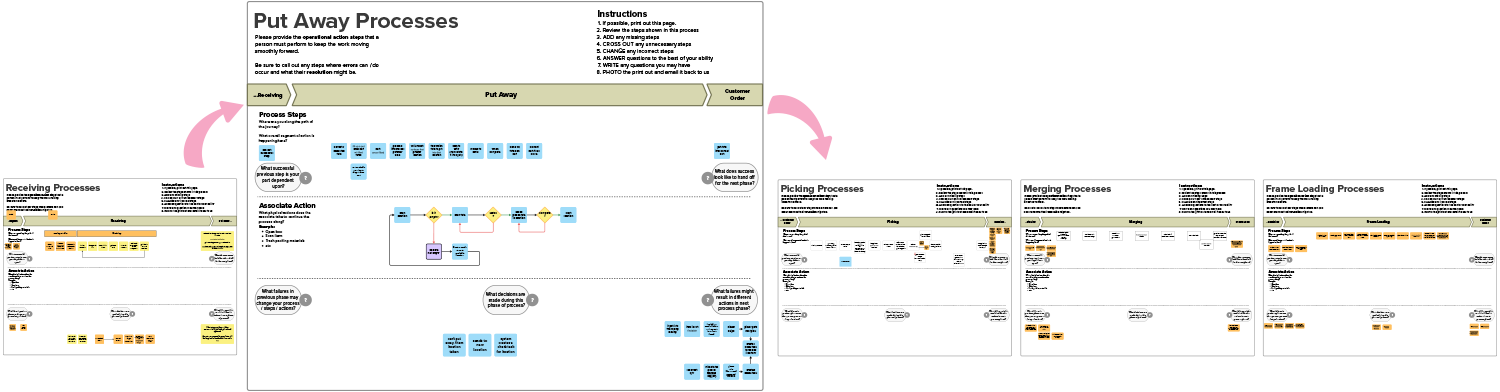
Final Service Blueprint

I created a service blueprint that mapped the full order lifecycle, from placement to delivery and exception handling. It showed how the grocery and alcohol fulfillment paths split and came back together, outlined key systems and decisions, and helped the team align on process flow, roles, and compliance needs.
